Inside the Deal: NCSOFT’s $103.8M Vietnam Acquisition – What Comes Next?
Now that the acquisition has officially gone through, we sit down with the man behind the deal, NCSoft's SVP of Mobile Casual Games, Anel Ceman, to learn more about what's to come, and how he finally cracked the Vietnam M&A deadlock.
What's in store following the $103.8m acquisition and what will be achieved
Following NCSOFT’s majority acquisition of Indygo Group, we see the next few years as a deliberate but ambitious expansion phase, both strategically and geographically.
In the near term, our focus is on building Indygo into a strong regional anchor. With its established presence and credibility in Vietnam, the studio gives us a solid foundation to increase visibility in the local market. We intend to leverage that momentum and publicity to identify, partner with, and potentially acquire smaller, high-potential studios in Vietnam and across the broader Asia region. The goal is to form a tightly connected cluster, with Indygo at the center, where teams can share best practices, technology, and creative direction while retaining their individual strengths and identities.
Looking further ahead, this clustered model becomes a blueprint for our global expansion in the mobile casual game space. Vietnam is a starting point, but not the endpoint. We envision establishing similar hub-and-cluster ecosystems in other key markets, each led by a strong central studio that understands local talent, culture, and player preferences. Over time, these regional hubs will be interconnected, enabling us to scale development more efficiently, diversify our portfolio, and respond more quickly to global market trends.
Ultimately, what we aim to achieve is a sustainable global development network—one that combines NCSOFT’s global capabilities with deep local expertise. By doing so, we want to consistently deliver high-quality, globally competitive titles while fostering long-term growth for our partners, our teams, and the regions we invest in.
Unlocking the dreaded Vietnamese M&A deadlock between founder expectations and buyer valuations
In Vietnam, the valuation gap has historically existed because many founder-led studios quite rightly focus on the intrinsic value of their teams, creativity, and long-term potential, while buyers tend to anchor more narrowly on near-term financial metrics. In this transaction, what ultimately unlocked that gap was a shared shift in perspective away from a purely standalone valuation.
From our side at NCSOFT, we were not looking at this studio simply as a company to scale in isolation. Our end goal is much broader. We see the studio as a foundational pillar for building a Vietnam-based development cluster, with the potential to become a central hub for the region and, over time, one of several interconnected global hubs. When viewed through that lens, the value extends well beyond traditional revenue multiples or short-term projections.
That longer-term, ecosystem-driven vision allowed us to recognize and price in strategic value that may not be fully captured in conventional valuation models—such as talent density, regional leadership, and the role this studio can play in accelerating our global mobile and casual strategy. Importantly, this also resonated with the founders, because it aligned with their own ambitions to build something enduring rather than simply optimize for a single exit moment.
In essence, the gap closed because both sides moved past a transactional mindset. By aligning on a shared long-term vision—one where this studio sits at the core of a larger Vietnam and Asia cluster within NCSOFT’s global network—we were able to bridge expectations and agree on a partnership that reflects not just current performance, but future potential.
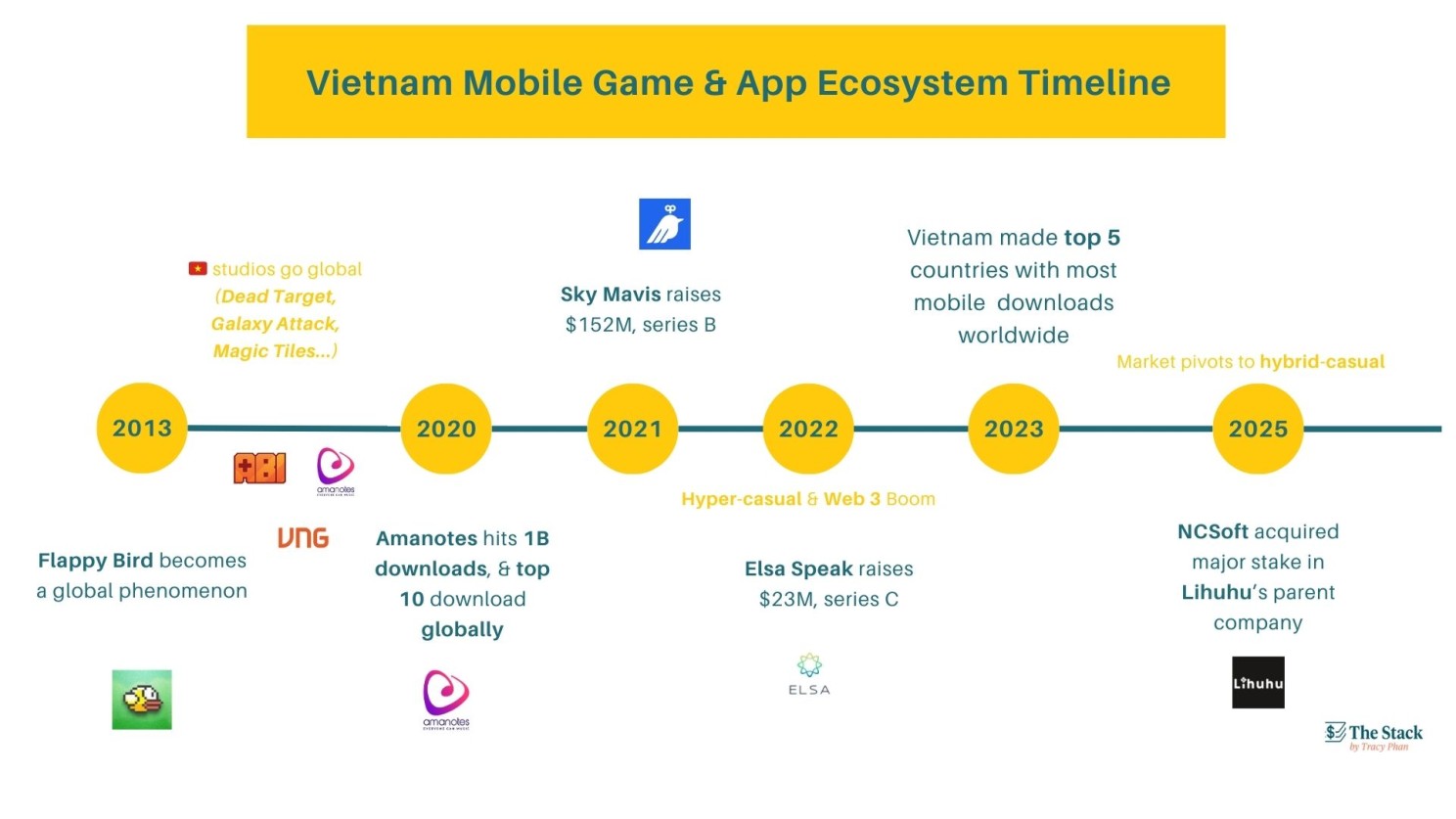
The advantage Vietnam carries for mobile casual
From my perspective, Vietnam’s single hardest-to-replicate advantage in mobile casual is its exceptional development agility. Vietnamese studios are highly effective at quickly identifying emerging trends, building lean prototypes, and releasing titles at speed. In a market where player preferences shift rapidly, that ability to move fast is often more valuable than large budgets or long production cycles.
This agility has proven especially important in today’s industry environment, where many global studios are struggling with high investment costs and slow turnarounds. Vietnam’s teams operate with lighter structures and shorter iteration loops, allowing them to adapt and remain competitive even as market conditions tighten. Recent industry coverage has highlighted how Vietnamese mobile games continue to perform strongly on global download charts despite broader market headwinds, underscoring the resilience of this model.
Ultimately, this combination of speed, pragmatism, and execution culture is deeply embedded in Vietnam’s development ecosystem. It’s not something that can be easily copied elsewhere, and it’s a key reason we see Vietnam as a long-term strategic hub for mobile casual development.
The hardest transition will be...
In my view, the hardest transition is not about a single factor by itself, but rather how decision-making speed and culture intersect after a majority acquisition. Cultural integration is a real challenge—particularly when you bring together teams from different countries, such as Korea and Vietnam, and from very different operating models. One is a highly systemized, process-driven corporation, while the other is a mid-sized, agile studio that thrives on autonomy and fast iteration.
The difference in scale naturally affects decision-making speed. Many high-performing casual studios succeed precisely because they can move quickly, experiment, and respond to market signals with minimal friction. A common failure point in acquisitions is when studios lose that freedom to operate; it’s something employees feel immediately, and it often leads to a loss of momentum and morale.
Our approach is to minimize that disruption as much as possible. Rather than operating on behalf of the studio, we focus on preserving autonomy while finding the right balance where structure and support actually help the team scale. Platform-level alignment and long-term optimization matter, but they should not come at the expense of speed or creative ownership. When done right, the acquisition strengthens what already works instead of replacing it.
The primary competitive edge amongst difficult cost efficiency and UA optimisation
As cost efficiency and UA optimization begin to plateau, the next competitive edge for Vietnamese studios will come from moving up the value chain in product depth and lifecycle management. We are already seeing leading teams expand beyond pure casual into more mid-core experiences, where deeper gameplay systems and progression can drive stronger engagement and differentiation.
At the same time, monetization is becoming more sophisticated. Rather than relying on aggressive or purely volume-driven models, studios are adopting more elegant in-game monetization approaches that are better integrated into gameplay and progression. This not only improves revenue quality but also strengthens player trust and long-term value.
Equally important is the investment in more advanced internal content and live-ops systems. These enable faster content iteration, longer retention, and extended game lifespans—critical factors as the market becomes more competitive. Together, these shifts position Vietnamese studios to compete not just on efficiency, but on sustainable product quality and long-term player relationships.
Advice for studios and publishers looking to enter the Vietnam market
For studios or publishers looking to enter and scale within the Vietnam game development market, the most important piece of advice is to approach the opportunity with deep respect for the local ecosystem rather than impose a one-size-fits-all operating model. Vietnam’s gaming industry is rapidly growing — with mobile games and original content increasingly taking center stage — and has become a vibrant production hub with thousands of studios and billions of downloads globally.
In practical terms, this means leveraging the strengths and culture of Vietnamese developers instead of trying to acquire and manage them in the same way you might a studio in your home market. Vietnam’s studios are known for their agility, trend responsiveness, and creative execution — qualities that have helped local teams thrive even as global development costs rise. Publishers who succeed here are those who empower local teams, respect creative autonomy, and act as partners rather than operators.
Additionally, understanding the regulatory and market landscape is critical. Compliance with local game licensing, content requirements, and evolving regulatory frameworks is essential for long-term success, and collaboration with local partners can help foreign companies navigate these complexities effectively.
Finally, invest in long-term ecosystem engagement — from building local relationships and talent development to supporting community events and culturally resonant content. Vietnam’s market is not only expanding in scale but is beginning to generate globally competitive original IP, and partnerships that embrace local creativity will be best positioned to contribute to and benefit from that growth.
You might also like











Home of the Gamesforum events series and leading mobile game analysis. Discover everything you need to know about mobile games marketing and monetization.