“Gray Zone” Creatives, Copycats & Monetization Misconceptions
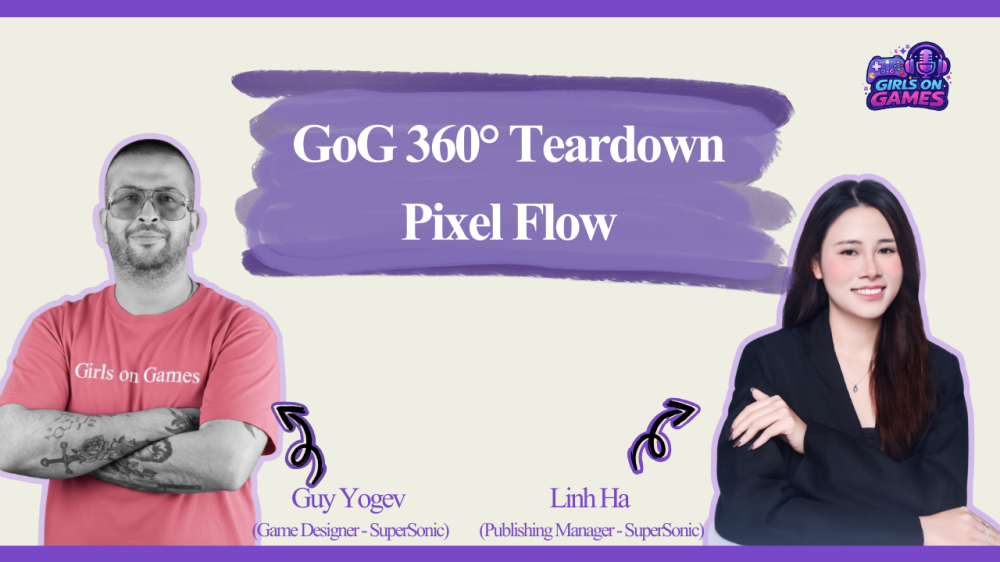
Yes, we touch ALL of those topics in our latest GoG episode, through the 360 degree lenses of Pixel Flow. From Game design, UA strategy to Monetization.
Why Pixel Flow Blew Up (And What Indie Devs Can Actually Learn From It)
It's me again, your resident mobile game nerd and Girls on Games host. If you've been anywhere near the hybrid-casual space lately, you've seen Pixel Flow everywhere. This little pig-conveyor puzzle game went from "cute new thing" to seven-figure daily revenue and top-25 US App Store grossing in just three months. Wild, right?
We had the absolute pleasure of diving deep into it on a recent Girls on Games episode with two amazing guests from Supersonic (Unity): Guy Yogev (game designer at Supersonic) and Linh Ha (Publishing Manager focused on Vietnam studios).
Joined by my co-host Trinh Thai, we tore down the game design, UA strategy, monetization playbook, behavioral metrics, and most importantly, what smaller/indie teams can realistically take away without massive budgets.
Full episode here: https://youtu.be/gaYcKG7jj5w
TL;DW: erm, to each your own I guess...
But here's the heart of it:
The Magic of Pixel Flow's Core Loop (Player-First Design Wins)
Guy nailed it early: games are recreational. We're not forcing anyone to play - people choose to play a game for fun, on the train commuting, in the office between breaks, in their bathrooms, wherever. Pixel Flow gets that psychology right.
The standout mechanic? Those adorable pigs on the conveyor belt. You tap to send a pig rolling along, it rains colored balls onto matching pixel cubes to clear them.
Run out of ammo? Pig hops into one of five waiting slots for later reuse.
Mess up? No instant death - you get a second chance (or at least you think you do).
But keep making careless moves, and your slots fill up with "wrong" pigs, adding gentle pressure.

As a player (I'm at level 86+ myself 😅), that "one more try" feeling is addictive. Guy calls it small, thoughtful player-experience tweaks that hook people emotionally.
Key lesson:
Always wear the player's hat.
Design for fun first, then layer pressure.
Puzzle games aren't one-size-fits-all — personas matter.
Competitive players like me love early choke points (like Color Block Jam squeezing by level 10–15).
Relaxed players want flatter curves (think Magic Sort hitting real difficulty at 70–100).
Pixel Flow lands somewhere smart in the middle.
Guy's golden line that broke my brain a little:
"In mobile game design, you don't invent — you innovate."
Every week, 2–4 Pixel Flow clones drop. Most fail. The winners tweak tiny things (background color, pacing, one mechanic twist) while nailing execution.
Inspiration is fine. One-to-one copying? Usually a dead end.
UA & Scaling: Flywheel, Funding, and Creative Volume
Trinh broke down why this wasn't luck: the founders (from Twisted Tangle) had skin in the game for years. They found product-market fit, then went laser-focused on scaling one title instead of shotgun-launching ten.
Their flywheel:
- Scaled with funding (seed round backed by E2VC + veterans) → no scarcity mindset.
- Heavy on "gray zone" creatives (leveraging familiar IPs/characters for lower CPI — controversial 🤷♀️ yes? but definitely effective).
- Massive volume: reportedly 3000+ creatives/week (playables + UGC from TikTok/YouTube "how to beat level X" videos).
- Balanced volume vs. ROAS early, then optimized hard.
For indie/Vietnamese studios: Trinh's advice hits home: puzzle games need 90–180 days to build meaningful user base. Don't choke UA because of early ROAS fear.
Funding or a working with a publisher can unlock that breathing room.
Behavioral Metrics > Raw Numbers (Linh's Super Insightful Take)
Linh shared Supersonic's split: raw metrics (CPI, retention, playtime) show what happened. Behavioral metrics (completion rate, win rate, session depth, first-time user experience) explain why and predict longevity.
Red flags that kill scalability even with hot early numbers:
- 100% handcrafted levels (players consume content 10× faster than you make it -margins die).
- Slow iteration speed in a fast market.
Look at early gameplay: Is the tutorial completed? Are players engaging the core loop? Are difficulty spikes causing sudden drop-offs? Raw D1 retention jump is nice - but without behavioral context, it's meaningless.
Monetization Done Right: Right Time, Right Place, Right Value

Pixel Flow pulls 10–13M/month IAP (Sensor Tower estimates) and reportedly 7-figure daily combined. Textbook hybrid-casual economy:
- Controlled sink inflation (retry costs 900 → 1900 coins → escalating).
- Aggressive but smart IAA: interstitials from ~level 10 (even on fail), ad removal package.
- Clear separation: IAP = hard progression value (powers, retries). Rewarded ads = soft value (extra lives, double coins). No cannibalization.
Guy's monetization wisdom:
Hybrid-casual is first a business model (dual ad + IAP). Build strong ad foundation first, gradually introduce IAP via FOMO (show rewarded-value bundles, then remove them temporarily).
Conversion happens when players are immersed - not in minute 1 with a pop-up.
My mantra (which Guy echoed): right time, right place, right value.
Let players feel the pain/friction first, experience the rewarded-ad taste, then hit them with IAP that solves it better.
Advice for Indie/Young Studios (Especially in Vietnam)
From Guy: Believe in yourself - this industry is brutal.
Master a simple, satisfying core loop first (3 repeatable actions). Make sure it's pick-up-and-play, relatable, and rewarding before adding layers. Target audience dictates monetization.
From Linh:
Inspiration is okay - innovate on top (change controls, angle, UX). Pure clones raise CPI, risk IP/legal issues, and hurt "made-in-Vietnam" rep long-term. Aim for original IP + operational excellence.
We're rising fast in execution speed and iteration. Next level? Create hits people talk about because of our ideas.
Final Thoughts
Pixel Flow isn't magic - it's obsessive focus on player psychology, smart innovation on proven mechanics, aggressive (but data-driven) UA, behavioral obsession, and a balanced hybrid model.
If you're building right now: start small, nail the core, test behaviors early, iterate fast, and don't be afraid to seek partners/funding when the data sings.
Huge thanks to Guy and Linh for the wisdom, Trinh for the sharp questions, and all you indie builders listening/reading. You've got this.
Until next time, keep creating & stay curious. Tracy Phan 💕 Girls on Games.
You might also like












Home of the Gamesforum events series and leading mobile game analysis. Discover everything you need to know about mobile games marketing and monetization.