Why “Not actual gameplay” is no longer a safe bet
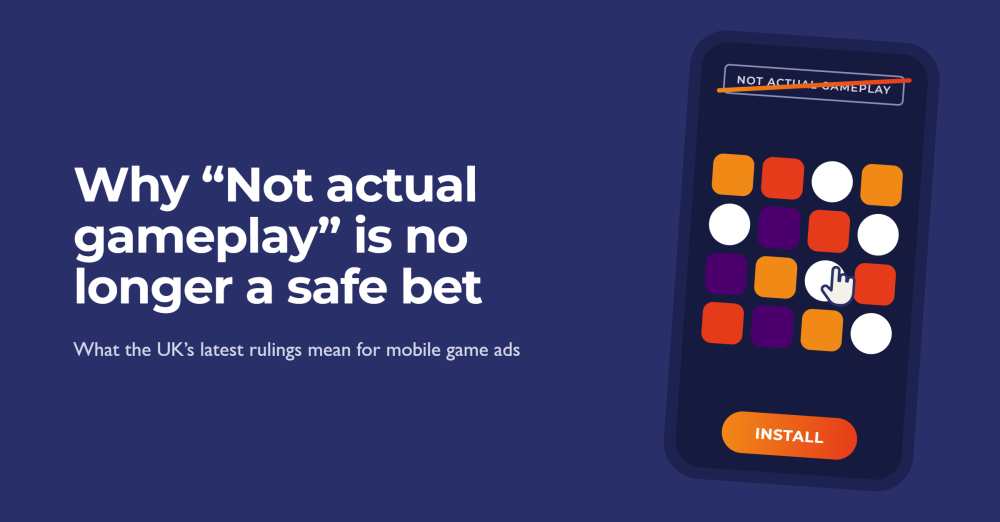
Mobile marketers have long relied on a small line of text to cover bold creative. Put a dramatic, made-up scenario in the hook, label it as not representative, and move on.
A new set of UK rulings suggests that approach is running out of road.
The rulings in brief
Earlier this week, the Advertising Standards Authority (ASA) upheld complaints against ads from four mobile publishers: King, Scopely, Omnilojo and Vistrex. The ads in question can’t be used again as they stand.
What stands out is who’s on the list. Two of these are among the most established names in mobile, with large, experienced creative operations. That makes the rulings worth reading closely, because they show where even well-resourced teams are drawing the line in the wrong place.
Three principles UA teams can take away
1. The test is the player’s impression, not the small print
King’s case is the clearest example. Its Farm Heroes Saga ad combined genuine puzzle mechanics with an invented rescue scene that never appears in the game. King relied on on-screen labels to signal the difference. The regulator wasn’t persuaded and judged that the labels muddied, rather than corrected, what a viewer would take away.
In practice, the regulator is asking what someone scrolling past would believe they’re downloading. If the creative is built to give one impression and the text says another, the creative wins.
2. Story is allowed, as long as it looks like story
The rulings were not a blanket rejection of cinematic advertising. In both the King and Scopely cases, a second ad was cleared because it was plainly a non-interactive scene.
The ads that failed shared one trait: they borrowed the visual cues of play. A pointer moving across a puzzle board, interface elements, or anything else that says “you can do this” was treated as a promise about the game.
For creative teams, that’s a useful distinction. Narrative hooks remain available. Dressing that narrative up as gameplay is where the risk lies.
3. Rare features don’t represent the game
Vistrex argued that the excavator gameplay in its ad did exist, in a bonus stage. The ASA looked at how often a player would actually see it. The stage is brief and appears only a handful of times across a long progression, so it didn’t reflect what the game is mostly about.
This builds on an earlier ASA position from its Evony decision: an ad should show what players will spend most of their time doing, not a feature they might occasionally encounter.
A note on badges. Omnilojo’s ads also carried award-style graphics that, by the publisher’s own account, referred to store placements rather than awards. The ASA still found them misleading. Any visual that implies recognition will be read as a claim of recognition.
A wider shift, not a UK quirk
It’s tempting to file this under local compliance. But global campaigns rarely produce separate creative for each market, so a UK problem quickly becomes everyone’s problem.
The rulings also land at a time when marketing claims are carrying real consequences elsewhere. This week, a US court restricted Papaya Gaming from moving funds overseas as it deals with a judgment of around $730m owed to Skillz following a false advertising case. The circumstances differ, but the message is consistent: what a game says about itself in its marketing can be tested and enforced.
The commercial case for honest creative
Nobody runs misleading ads by accident. They exist because spectacular hooks tend to win the first few seconds and bring down install costs.
But an install is only the beginning. Someone who downloads a game expecting a rescue puzzle or an open-world driving sim, and finds something else, has little reason to stick around. The saving at the top of the funnel can easily be lost further down, in churn and weaker returns.
Seen this way, representative creative isn’t a constraint on performance. It’s a way of buying the right players in the first place.
A quick audit for your live creative
Before the next campaign goes out, it’s worth running each ad past a few simple questions:
- Could a new player do everything shown within their first sessions?
- Is any non-interactive scene obviously non-interactive?
- Would every badge or claim hold up if someone asked for proof?
If an ad only passes with a disclaimer attached, it probably doesn’t pass.
The small print had a long run as mobile advertising’s safety net. The publishers that move on from it first are likely to find that being straight with players is good for compliance and good for growth.



Home of the Gamesforum events series and leading mobile game analysis. Discover everything you need to know about mobile games marketing and monetization.