We Broke Down the State of Gaming 2026 Mobile Gaming Data So You Don’t Have To
By Mariam Ahmad 26 February 2026
Most of last week, I have been digging into Sensor Tower’s State of Gaming 2026report's mobile section to understand what’s really happening beneath the headline numbers.
At first glance, it looks stable: revenue is up slightly, the market feels mature, nothing dramatic. But once you start breaking down installs, time spent, genre shifts, and monetization mix, a very different story emerges.
Downloads are falling. Strategy is the only genre growing across revenue, installs, and engagement. Hybridcasual is quietly reshaping monetization (that one is unsurprising). And ad mix is becoming a defining strategic lever rather than a secondary revenue stream.
Here’s are the main points on where mobile gaming stands.
Let's lay out the facts first
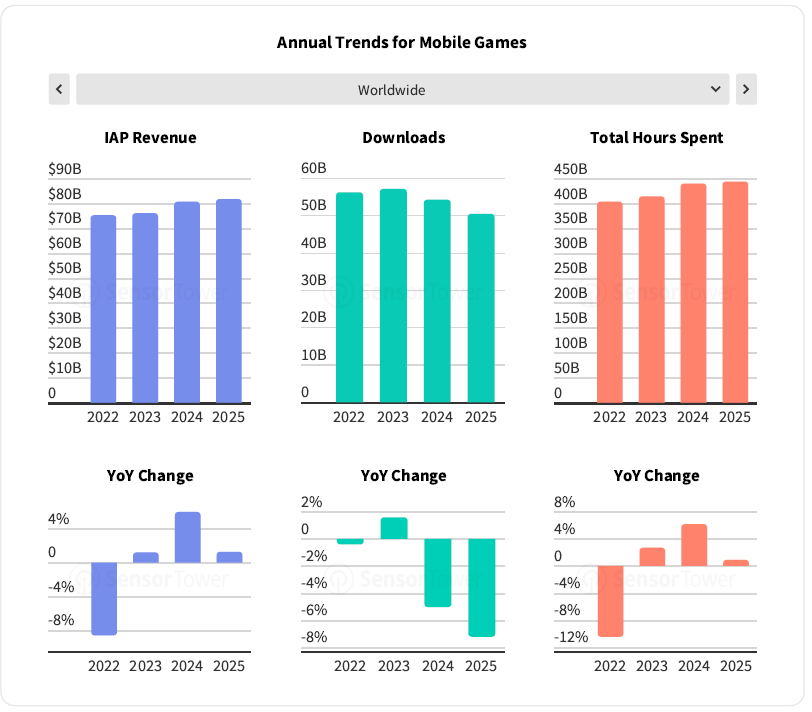
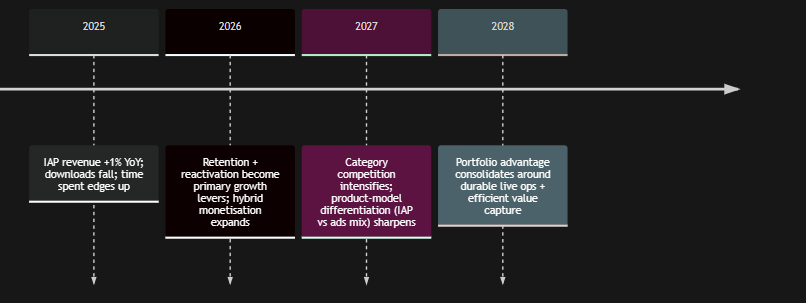
Mobile gaming in 2025 looks like a market that’s stopped growing “outwards” (installs) and started squeezing harder “inwards” (value). The report’s mobile section calls out a +1% year-on-year rise in IAP revenue even as downloads fell, and notes that time spent rose slightly - a classic signal that the next wave is about LTV rather than raw acquisition.
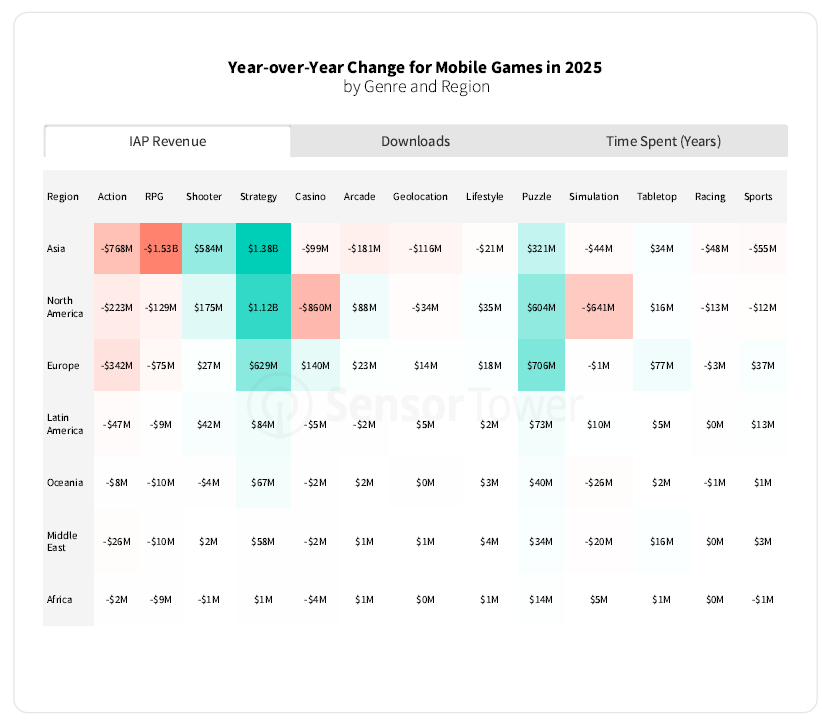
The big winners are clear: Strategy (especially 4X) is the only genre the report flags as growing downloads across key regions, and it also delivered the largest IAP revenue uplifts:+US$1.38B in Asia, +US$1.12B in North America, and +US$629M in Europe.
Geographically, the centre of gravity is shifting. Asia-headquartered publishers collectively added +US$2.58B YoY IAP revenue, while North America declined by -US$1.78B. Europe posted a smaller net gain (+US$0.36B).
Monetization is holding, but the funnel is shrinking
The most important sentence in the mobile section is basically: “Revenue held up; downloads didn’t.” 2025 marked the third straight year of revenue growth across the App Store and Google Play (as measured by IAP), with IAP revenue up 1% YoY even as downloads fell.
That combination changes what “good” looks like. When growth is constrained at the top of the funnel, teams don’t win by buying more players; they win by extracting more value from the players they already have - through sharper segmentation, better reactivation, tighter payer management, and higher conversion efficiency (the report explicitly frames the shift as away from “volume” and towards “payback and conversion”).
Mobile gaming’s 2025 divergence: IAP revenue up (+1% YoY) while downloads fall - time spent edges up, signalling LTV pressure over install volume.
You don't monetize what you don't retain
Global downloads softening and revenue growth slowing reflect what many developers recognise: mobile gaming is a mature market in a more efficiency-driven phase.
It is tempting to frame payer conversion, ad monetisation and retention as competing priorities. In 2026, the opportunity is not choosing one lever over another, but aligning all three within a coherent strategy.
Retention remains under pressure across most genres, while acquisition costs continue to rise. Studios must do more with less.
Deeper payer monetisation only works if engagement is durable. Hybrid ad integration only scales when it complements rather than disrupts the player experience. Monetisation can no longer sit downstream of product decisions. It must be embedded within the core loop in a way that feels balanced and fair.
Euan Cowen, Director of Growth & Monetization, Super Banana
Genre and region: 4X Strategy vacuumed up the growth
If you only remember one where did the money go? story from 2025 mobile: Strategy. The report attributes the surge to a wave of 4X Strategy titles from Eastern publishers, naming Last War: Survival and Whiteout Survival as leaders.
What makes this more than a vibe is the regional IAP delta. Strategy generated the largest positive swings in the biggest markets tracked:
Asia: Strategy +US$1.38B YoY IAP revenue (biggest gain), while Role-Playing Game (RPG) is the largest drop at -US$1.53B.
North America: Strategy +US$1.12B (biggest gain), while Casino fell -US$860M (largest drop).
Europe: Puzzle +US$706M (biggest gain), with Strategy also strong at +US$629M; meanwhile Action declined -US$342M.
Puzzle is the other standout, especially in Europe, where the section highlights Royal Match reaching the top spot and Gossip Harbor driving the biggest uplift.
Kingshot proves 4X is still the growth engine
The biggest winner of 2025 is Kingshot, which is the new 4X kid on the block that achieved its rise to top revenue charts even faster than its bigger brother Whiteout Survival. Because he is the upgrade of its brother, with better UA creative spin as currently every single genre in mobile is running Kingshot style creatives, doesn't matter if you are midcore or casual you are running it, because 4X has the best UA that everybody is stealing from.
I think we are still a few years away from the 4th generation of 4X games. I am talking about the jump that Whiteout Survival and Last War did to take out the 2nd generation leader Lilith's Rise of Kingdoms. I think current state will still continue for 2026 and the ball is now on Rivergame's side of the field, so I would expect a big 4X release from them this year, which will again grow the overall market.
Jakub Remiar, Co-founder, two and a half gamers
Shooters, meanwhile, show a very “launch-led” pattern in Asia: Shooter IAP revenue +US$584M in Asia, with the report citing new launches led by Delta Force.
A subtle but crucial point: the report says Strategy was the only genre to grow downloads across Asia, North America, and Europe. That matters because it implies Strategy is one of the few places still expanding reach in major markets. (The section notes that downloads declined across other genres in major regions, with especially steep declines for Lifestyle, Simulation, and Puzzle.)
Strategy’s gains are broad-based across regions, while declines are clustered in formerly dominant categories like RPG and Action.
Hybridcasual is learning to print money, hypercasual is stealing the clock
The report draws a straight line from shrinking downloads to monetization innovation - and product model performance backs that up. The report says: Hybridcasual was the standout monetization gainer in 2025, with revenue up sharply, while Casual and Mid-core were essentially flat. Downloads declined across those three models; Hypercasual was the only model to post download growth.
Monetization models under install pressure (2025 signals)
What’s more interesting (and a bit uncomfortable for “traditional” IAP-first teams) is attention. The report says Hypercasual time spent surged, and emphasises that this wasn’t only in Tier 2 markets: it also rose in major markets like the US, Japan, and Western Europe.
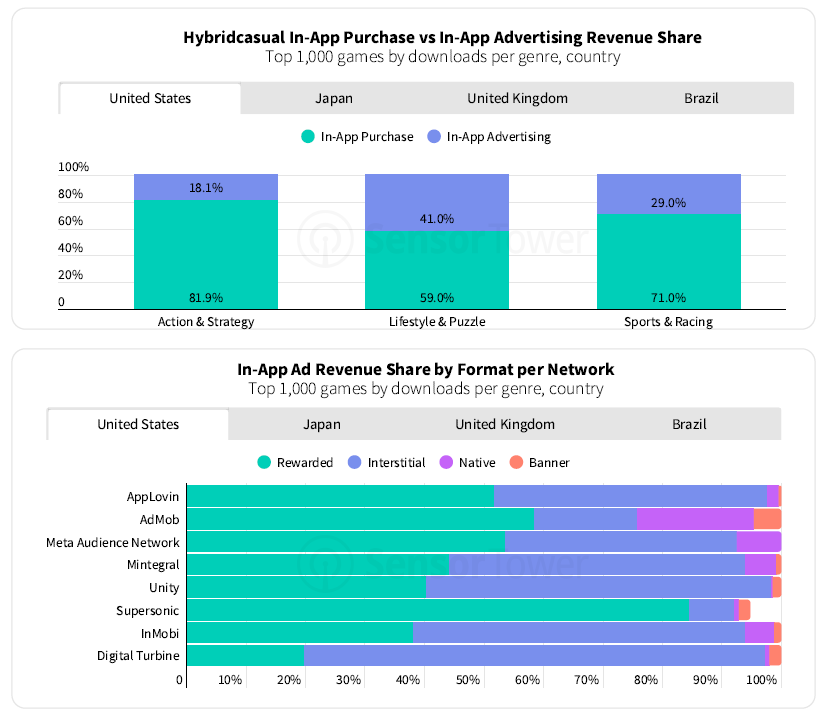
Lifestyle & Puzzle is materially more ad-driven than other hybridcasual clusters. Across four major markets referenced (the US, Japan, UK, Brazil), the report shows:
If you’re trying to reconcile falling installs with stable revenue, that 41% ad share is your “how”.
Scaling revenue without sacrificing retention
While hybridcasual games are increasingly driven by ad revenue, Nekki’s portfolio leans more toward midcore action titles. For us, ads are not the primary monetization driver but an alternative payment method within the economy.
We treat advertising as a form of payment — players pay with their time. This framing helps preserve value perception and ensures rewarded video supports the economy rather than undermines retention.
Rather than increasing ad pressure in a linear way, we increase the diversity of opportunities available to players. More tailored rewards, clearer value exchange, and segmented ad exposure allow us to scale revenue without compromising long-term engagement.
Maksim Amosov, Head of Monetization, Nekki
Hybridcasual’s playbook is bifurcating: Lifestyle/Puzzle titles lean far harder on ads (41% share) than Action/Strategy (18%), changing what good unit economics means by sub-genre.
Retention is the tax you pay when a portfolio gets old
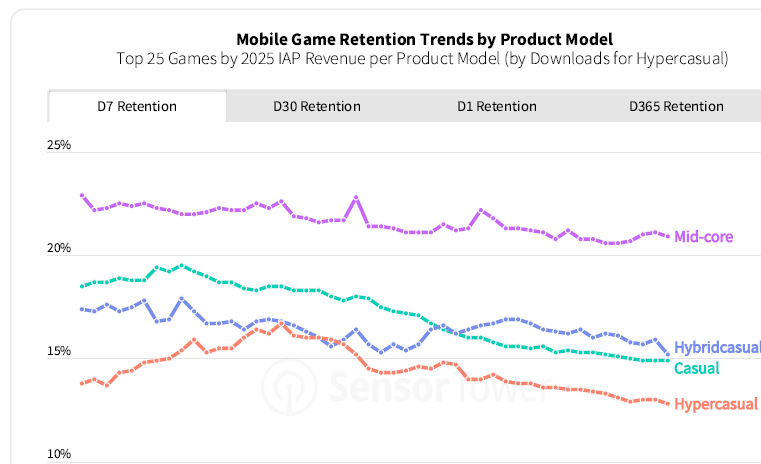
The report makes a pretty clear statement in: Casual has a retention problem. It finds that top casual games’ day 7 retention steadily declined from early 2022 through late 2025, and that hybridcasual improved relative performance, now sitting above casual on D7 (with other windows showing a similar softening for casual).
And yet, the report gives one concrete proof that it’s not “inevitable market physics”: Century Games’ Tasty Travels is cited as a standout, with D7 retention at 22% at the time of reporting.
This is why the 2026 conversation will keep snapping back to live ops craft and novelty velocity. If your baseline D7 is sliding, you can’t monetize your way out forever - you need stickier early loops, cleaner onboarding, and more reliable reactivation beats.
Casual’s D7 retention has softened for years, while hybridcasual improves - one more reason the industry is pivoting from acquisition to durability.
Retention first. Monetization second
Retention is the priority, as it strategically grants you the right to monetize. When installs drop and the cost per user rises, you can no longer compensate for losses with scale; therefore, any churn becomes a direct hit to revenue.
In this situation, Retention becomes the foundation, directly determining LTV, UA payback, and long-term stability. Monetization per user shifts to the second priority and must be optimized cautiously to protect the UX, with no aggressive increase in ads and a focus on deeper segmentation.
Ultimately, when installs fall, the value of each user grows: Retention becomes the base and monetization acts as a multiplier, shifting the focus from ad volume to ad value.
Katerina Maliaran, Head of Ad Monetization at Burny Games
There are no magic signals - only testing
To successfully balance ARPDAU growth with long-term retention, the most effective strategy is granular user segmentation. Instead of applying a one-size-fits-all ad load, the ideal approach goes beyond simply dividing the audience into payers and non-payers. We need to identify deeper behavioral segments and apply a unique, tailored monetization strategy to each of them. This approach allows us to maximize not only ad ARPDAU but also overall ARPDAU across the entire player base, without negatively impacting long-term retention.
Regarding signals that ad monetization is eroding LTV, the hard truth is that catching isolated behavioral signals is practically impossible. The only reliable method to measure this is through A/B testing. By testing different ad frequencies and placements, you can clearly measure their direct impact on retention and overall LTV. There are no magic signals yet; continuous experimentation remains our single source of truth.
Daniil Sadykov, Head of Ad Monetization, MY.GAMES
Forecast: the next cycle is an LTV arms race
The report's mobile section stops short of giving explicit numeric forecasts (no specific 2026–2028 revenue/download figures are stated in the pages available), but its directional implication is hard to miss: when downloads contract and UA gets more expensive, advantage shifts to teams that monetize deeply from a stable base - something the report explicitly ties to Eastern publishers’ “monetization-forward” experience.
Still, paired with the mobile section’s 2025 story (flat installs, resilient spend) the direction is consistent: it seems like growth becomes consisted on who can keep players and compound value per user.
*All data is from Sensor Tower
Hear from Burny Games, Jakub, and others at Gamesforum Cyprus - tickets available here.