The Ask Gap in Game Dev: Why “Just Ask for More” Fails Women
Written by Tanja Loktionova, Founder at Values Value, Co-Founder at InGame Job, and Women in Games Ambassador.
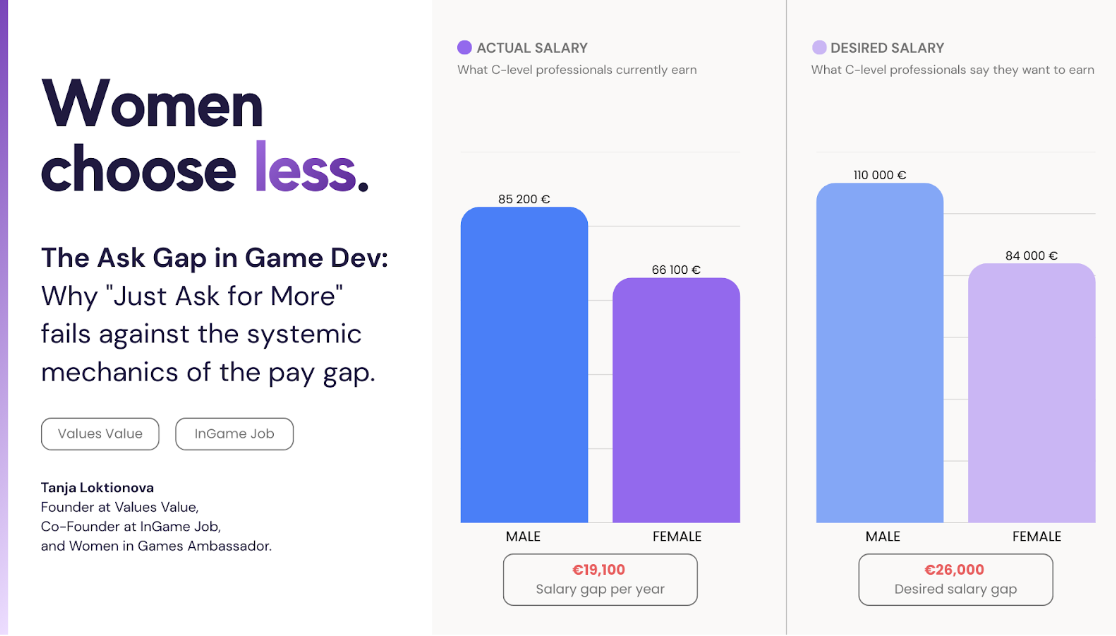
Data from the Big Games Industry Employment Survey shows that women not only earn less than men in comparable positions, but their desired salaries are often lower than those of their male colleagues.
Year after year, the share of women in the gaming industry continues to grow. They are taking on more roles in development, art, production, marketing and management. One might assume that this growth would naturally reduce structural imbalances. Yet, one of the most persistent issues remains: the gender pay gap.
To understand the roots of this disparity, we asked Tanja to break down why the old approaches don’t work and how the "math of inequality" actually functions.
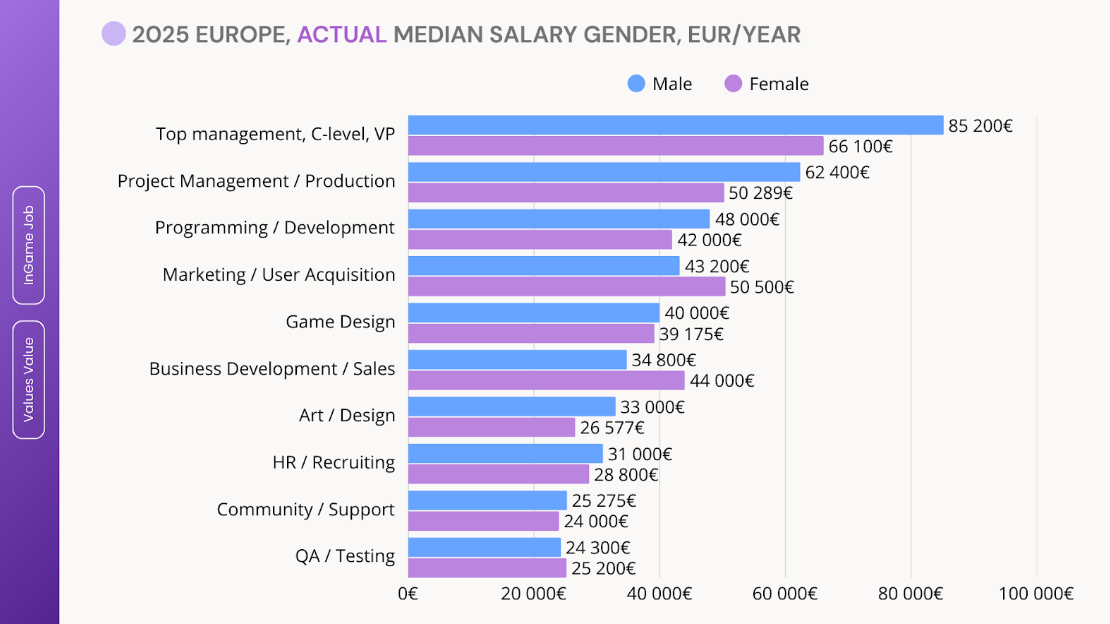
Data shows that women not only earn less than men in comparable positions, but their desired salaries are often lower than those of their male colleagues.
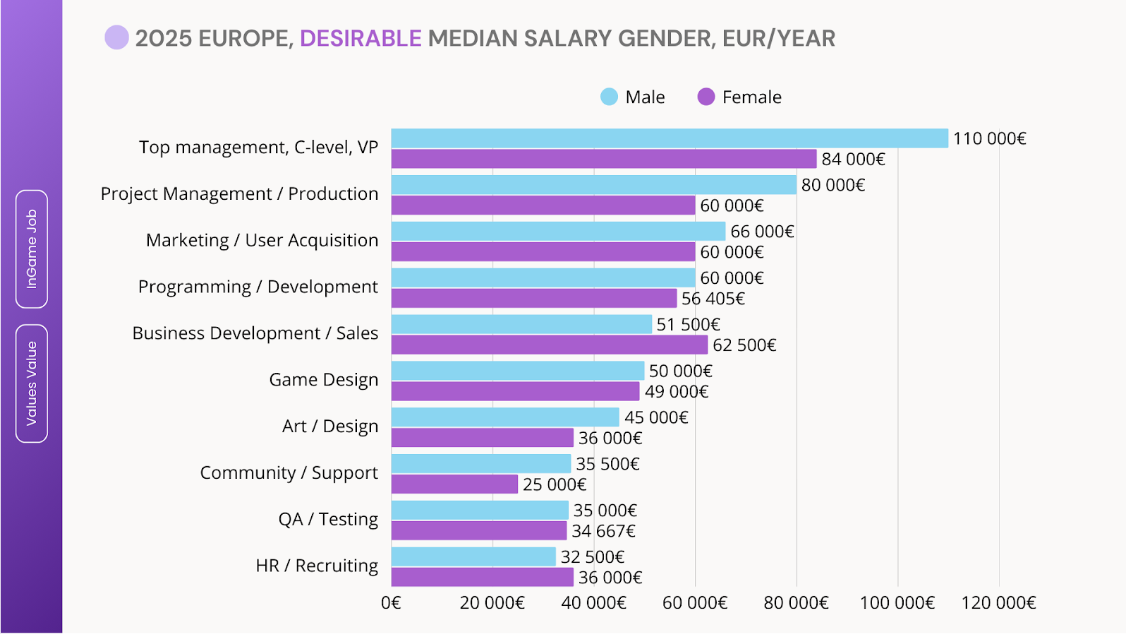
It is tempting to conclude that the pay gap is simply a result of women’s lower salary expectations. However, viewing this as a personal choice rather than a systemic outcome overlooks the nuanced reality of how the industry operates.
Looking Beyond “Just Ask for More”
The gender pay gap has always sparked the most lively discussions around our survey results. It's a subject that hits close to home for many.
For years, I pointed to negotiation confidence as the lever women could pull. It was practical advice to just ask for more, and the data seemed to support it. But the more I looked into the actual science of the Ask Gap, the clearer it became that we were asking the wrong question entirely.
Harvard research on the backlash effect, longitudinal data on salary anchoring, and the new WAGEFAIR project in Europe all point in the same direction. The gap is not a confidence problem. It is a structural one. And the solutions have to match that reality.
The Science of the Ask Gap: It’s Not About Confidence
The Ask Gap is not a lack of courage; it is a deeply rooted phenomenon that begins long before a first job offer. Scientific research shows that the problem requires a much broader perspective:
- Backlash Effect: Harvard studies show that women initiating negotiations are often perceived more negatively than men making identical requests.
- Early socialization: Scientific American describes a “sticker experiment,” in which girls as young as 8 ask for lower rewards for their work than boys.
- The WAGEFAIR Project: Launched in Europe in September 2025, this scientific project focuses on pay equity. Its core premise: if the Ask Gap exists, the solution cannot rely solely on “teaching women to negotiate.” Cultural norms around what is considered a “fair salary” need to change.
Structural penalties: Career breaks (for example, maternity leave) and lack of salary transparency in our industry further weaken women’s negotiating position.
The Glass Cliff and the Senior-Level Trap
Our report’s data clearly and consistently shows that the pay gap grows with seniority. While the difference at the Junior level is minimal, at Senior and C-level, female leaders often earn significantly less than men.
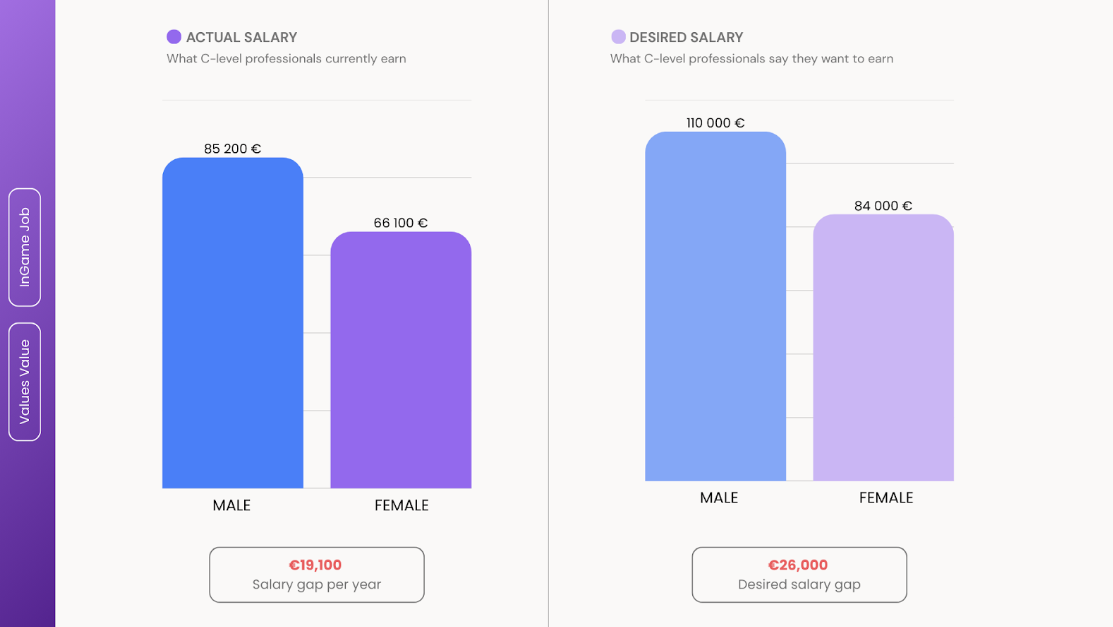
Why Does this Happen?
At Junior/Middle levels, salaries are relatively standardized by the market. But the higher the position, the more “gray areas” appear in compensation: bonuses, stock options, equity, and individualized terms.
Within these individualized negotiations, unconscious biases come into play. Men are more often paid for potential and future achievements, while women are paid for proven results and past accomplishments.
There is also the Glass Cliff effect: women are often hired into top positions during company crises. In such circumstances, their negotiating position is weaker: “be grateful that you got a chance to save the studio.”
The gender gap is a financial snowball rolling according to the principle of compound interest.
When discussing the Ask Gap at the start of a career, the numbers often don’t seem alarming. A female Junior developer might request 5–7% less than a male colleague with the same portfolio. It seems easy to fix: “She’ll gain experience, become more confident, and catch up at the next review.”
But corporate compensation math works differently:
- In most studios, raises are calculated as a percentage of the current base. A 10% promotion on a $3,000 base is $300; on a $3,200 base, it’s $320. Each year, with each new performance review, the absolute gap grows, even if the percentage increase is identical.
- When moving to a new company or position, the desired offer is often shaped with reference to current earnings. If a woman fell victim to the Ask Gap at the start, this low “anchor” follows her from company to company.
The higher the grade, the smaller the portion of income is the base salary, and the larger the portion is bonuses, profit sharing, and stock options. But all of these bonuses are calculated based on the base salary.
- A 30% annual bonus for a female lead with a lower base will be mathematically smaller than a male lead’s bonus.
Equity and stock options are also tied to the employee’s financial weight.
What starts as a harmless $200 difference at the entry point can turn into a 25–30% gap by the time someone reaches Technical Director or CMO.
Why Women’s Salaries Reflect the Future of the Industry
The gender pay gap in game development affects 25% of the current workforce, and this share is growing. This is important not only from a fairness perspective.
As the share of women in game development gradually grows across all disciplines, a persistent pay gap affects not just women. Over time, it shapes the salary dynamics of the entire industry.
Not because women are responsible for stagnant salaries, but because systems that undervalue one group inevitably influence everyone. When a significant portion of talent is systematically undervalued, market benchmarks for all are distorted. Opaque pay structures that emerge from or reinforce inequality suppress transparency across the board. The problem is not limited to one group, it spreads.
From “Fix the Women” to “Fix the System”
Teaching women to “ask correctly” is pointless if the rules of the game remain hidden.
The Ask Gap, although real, is a consequence of the system, not a personal trait. Fixing individual behavior without changing the environment provides personal gains, but no systemic progress.
What works:
- Salary transparency at all levels, especially Senior and C-level, where informal negotiations create more opportunities for bias.
- Regular compensation audits: companies should check whether employees in comparable positions with similar KPIs have equal pay, regardless of the initial request.
- Blind hiring evaluation: removes gender markers when assessing skills and reduces bias before the offer stage.
- Normalization of parental leave for all genders: when the career impact of taking leave is evenly distributed, gender inequality disappears.
- Transparent bonuses and equity: at senior levels, the largest portion of compensation is the least transparent. Clear formulas, not discretionary decisions, remove the most powerful lever of inequality.
We conduct the Big Games Industry Employment Survey to give the industry a tool for real change. We present real data to spark dialogue and explore ways to improve compensation practices.
The full report is available here: Big Games Industry Employment Survey 2025
You might also like












Home of the Gamesforum events series and leading mobile game analysis. Discover everything you need to know about mobile games marketing and monetization.