“You Can’t Fully Attribute Organic - But You Can Model the Halo”: ASO × UA Strategy With Burny Games
In this piece, Alisa Eren, Organic Growth Lead at Burny Games, breaks down how paid user acquisition fuels measurable organic uplift - and how disciplined ASO experimentation protects blended CAC. She shares how her team quantifies halo effects, operationalises high-frequency store testing, and aligns creative learnings from UA with conversion strategy to turn short-term spend into long-term organic growth.
How do you delineate and measure organic uplift driven by paid UA — specifically, how do you quantify halo effects across app store search and branded queries?
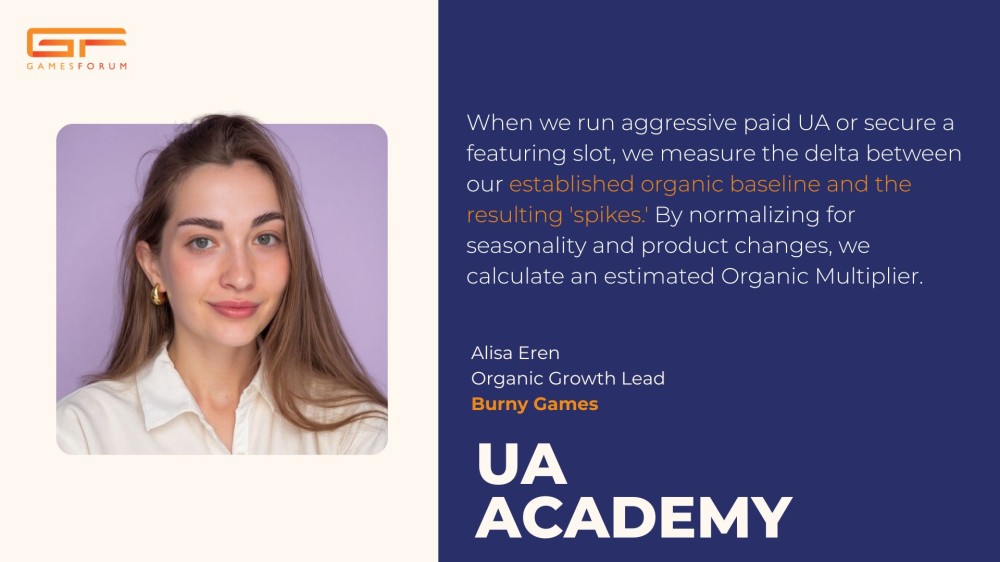
While 100% attribution for organic uplift is practically impossible due to the attribution overlap, we utilize a baseline correlation model. When we run aggressive paid UA or secure a featuring slot, we measure the delta between our established organic baseline and the resulting “spikes.” By normalizing for seasonality and product changes, we calculate an estimated Organic Multiplier. We acknowledge a margin of error, especially during high-spend periods, so we look at long-term data windows to validate the halo effect on branded search volume and category rankings.
What is your current ASO experimentation framework, and how tightly is it integrated with paid creative learnings from Meta or TikTok?
Our framework relies heavily on close collaboration with the UA team. We don't run isolated tests on social platforms, but we regularly leverage their “best performers” to inform our ASO roadmap. We utilize Custom Product Pages (CPPs) to maintain visual consistency between specific ad creatives and the store landing page. If a UA creative highlighting a unique feature outperforms others, we immediately move it into a store A/B test. We also experiment with aligning our subtitles and long descriptions with the core messaging found in top-performing paid assets.
How are you leveraging first-party behavioural cohorts (retention, monetization depth, session frequency) to refine both organic conversion rates and paid targeting models?
Currently, our organic audience quality is inherently high due to effective store indexing and intent-based search queries, so retention and session frequency usually meet our benchmarks. Rather than using these cohorts to refine targeting (which we leave to the UA side), we focus on Conversion Rate Optimization (CRO). We use behavioral data to identify where the “message-to-product” fit can be improved in our store listings and promotional in-app event cards. We only deep-dive into behavioral cohorts if we detect a negative trend that suggests a mismatch between our store assets and the actual gameplay experience.
What role does SEO and content acquisition play in your growth mix, and how do you attribute downstream installs or sign-ups to top-of-funnel organic content?
SEO and content acquisition are currently in an experimental phase. We are exploring web-to-app flows through blog content and UGC initiatives. However, these are not our primary growth drivers at this stage. Given the high resource investment and the non-linear path to ROI in these channels, we maintain them as supplementary “top-of-funnel” experiments while focusing our main efforts on high-impact ASO and UA synergies.
Are you building structured referral or virality loops inside the product, and how do you model their K-factor relative to blended CAC?
Structured referral programs and K-factor modeling are currently on our long-term roadmap but are not a current priority. Our current growth strategy is focused on optimizing the conversion funnel and scaling through proven organic and paid channels. We plan to revisit virality loops once we reach our next milestone for baseline organic stability.
How do you approach conversion rate optimization on store listings — do paid UA creatives inform organic screenshots, value props, and keyword targeting?
We take a high-frequency testing approach to CRO. We actively use CPPs to segment audiences based on keyword clusters and UA campaign themes. Our framework includes classic A/B and A/B/B visual tests, localized experiments for key regions, and keyword-specific landing pages. We are in a state of “perpetual testing,” constantly iterating on screenshots and value propositions to ensure the store listing reflects the most current user preferences and market trends.
In a privacy-constrained environment, how are you aligning organic retention signals with SKAdNetwork or modeled attribution to improve paid acquisition efficiency?
In a privacy-first environment, the alignment of organic signals with SKAN or modeled attribution is primarily handled by our Data Analytics and UA teams. While we have established internal frameworks and processes in this area, we're not in a position to share specific methodologies or proprietary insights at this stage, as these represent core elements of our competitive data infrastructure.
What is your framework for balancing brand search capture organically versus bidding defensively on branded terms in paid UA to control blended acquisition cost?
This is a strategic balancing act. While it sometimes feels like “competing with ourselves,” I view defensive branded bidding as a necessary protective mechanism. If our brand generates significant search volume, we must ensure we own the top “real estate” to prevent competitors from conquesting our intent. We aim to balance the blended CAC by monitoring whether paid brand capture is truly incremental or simply shifting organic clicks to paid, but protecting the brand moat remains the priority.

You might also like












Home of the Gamesforum events series and leading mobile game analysis. Discover everything you need to know about mobile games marketing and monetization.