It’s Not the Bids: Why Creative Is the Only Real UA Advantage Left
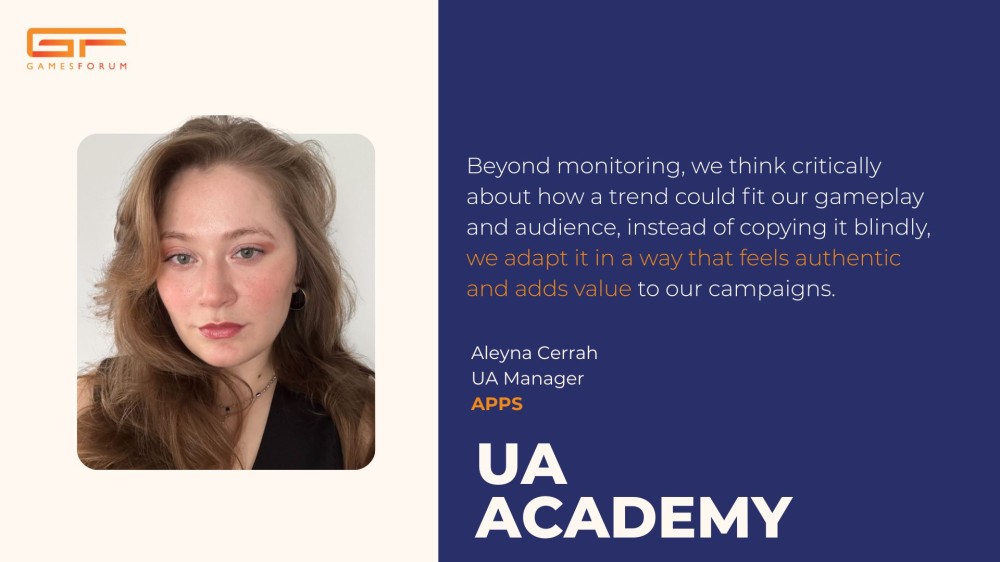
In a UA world crowded with the same bids, networks, and audiences, only one lever truly separates winners from the rest: creative. Ahead of Gamesforum Barcelona, APPS’ UA Manager, Aleyna Cerrah, shares sharp insights on what makes campaigns stand out when performance is non-negotiable.
Your keynote at Gamesforum Barcelona will explore creative success in crowded markets - how do you personally define what makes a campaign ‘stand out’ in today’s oversaturated digital landscape?
It’s not the bids. It’s not the networks. It’s the creative.
In today’s UA landscape, there are only a few levers we can pull to truly impact campaign performance: adjusting bids and optimizing creatives. Bids usually stay within a narrow range to maintain a balance between scale and ROAS, there’s only so much flexibility there.
But when it comes to creatives, that’s where we’re limitless. It’s the one area where we can truly stand out.
Most of us are working with similar bids and targeting the same key geos. What really drives scale is the creative’s performance, its ability to capture attention, drive clicks, and get users who bring long-term value. A strong creative isn’t just about looking good; it’s about performance and finding that perfect balance between standing out and converting the right players.
In your experience, how do you balance data-driven decision-making with the gut instinct and creativity that great campaigns require?
For me, balancing data and creativity is all about using insights to guide, not replace intuition. I always start by analyzing creative test results and comparing them with how actual campaigns are performing. Data shows me what works, what has potential, and what doesn’t, but it doesn’t tell the whole story.
Analysing test results makes it easy to identify high-performing creatives, but what truly requires intuition is spotting concepts that may perform poorly initially yet have potential if we iterate on them. By tweaking elements, adding or removing features, we can often turn a mediocre test into a strong performer. Creativity also comes into play when spotting trending creatives in the market and thinking about how to adapt those ideas to fit our gameplay in a unique and engaging way.
I also take initiative: sometimes I use creatives that I believe will perform well, even if they haven’t been tested or previous test results weren’t strong. Usually in every 5 creative I test like this, scales in the campaign.
The data still leads the direction, but creativity and personal judgment still drive the concept.
Many UA teams struggle to innovate under performance pressure - what’s your approach to keeping creativity alive when KPIs are tight?
Keeping creativity alive in all cases requires structure and planning. In APPS, we define a creative production pipeline that allows us to spread both the financial cost and the workload over time, so we can continuously test and iterate without putting all resources at risk at once.
We also focus our trend testing within our category. While top-performing games in other categories can be inspiring, their ideas don’t always translate to our audience and often require higher budgets. By staying category-focused, we can experiment with trends that are more likely to resonate with our players while maintaining efficiency and performance.
How do you and your team stay tuned into cultural trends that inform creative direction without falling into short-lived “trend chasing”?
We focus on understanding the lifespan and adoption of those trends in the market. We monitor how many apps in our radar have used a specific trend and how long their creatives stayed active. This helps us distinguish trends that have real staying power from ones that burn out quickly.
Beyond monitoring, we think critically about how a trend could fit our gameplay and audience, instead of copying it blindly, we adapt it in a way that feels authentic and adds value to our campaigns. The goal is to use trends as inspiration, not a shortcut, so our creatives remain both timely and effective over the long term.
What drew you to APPS, and how has your journey there shaped your approach to user acquisition and creative testing?
During the hiring process, one line really stuck with me: “We want you to make mistakes.” That resonated immediately. At APPS, you’re given the freedom to try, fail, and learn, and that approach has been incredibly formative for me. It encourages experimentation, reflection, and constant improvement.
I was also looking for a role in true performance marketing, where every action is guided by data. APPS gave me the opportunity to take ownership, to plan my own tasks, manage my experiments, and directly see the impact of my decisions. This environment shaped my approach to user acquisition and creative testing: I rely on data to guide decisions, but I also feel empowered to take calculated risks and iterate quickly when I see opportunities to improve performance.
What’s something about APPS’ culture or creative process that you think gives the team a unique edge in a crowded market?
One thing that gives our team a unique edge is that we’re small and agile. This allows us to adopt trends quickly, communicate effectively within the team, and coordinate seamlessly with other teams. We also have a strong collaborative rhythm with the product team, meeting monthly to share our creative strategy, discuss what’s working, and explore new approaches.
This combination of speed, clear communication, and close collaboration means we can test and iterate on creatives faster than larger teams, stay ahead of trends without blindly chasing them, and ensure our campaigns are both innovative and aligned with the product vision.
If you could give one piece of advice to new UA managers trying to break through creatively, especially in fast-moving app categories, what would it be?
My advice to new UA managers is simple: test as many creative concepts as you can. Every new concept has the potential to unlock a new audience. Don’t limit yourself to variations of what already works, focus on keeping concept variety within your campaigns so your creative pool stays fresh and diverse.
Also, stay curious. Check your competitors and top-performing apps regularly, not to copy them, but to understand what’s resonating in the market. Sometimes you’ll spot patterns or opportunities that even your creative team hasn’t noticed yet. The more you test, observe, and learn, the more you’ll sharpen your instincts and find creative breakthroughs that drive real performance.

You might also like












Home of the Gamesforum events series and leading mobile game analysis. Discover everything you need to know about mobile games marketing and monetization.